A clear version.
Everyone knows which changes will reach the working system.
Everyone knows which changes will reach the working system.
The new scenario is assessed in a safe environment where needed.
There is a process for cutover and confirmation of the result.
We discuss recovery and the limits of data rollback in advance.
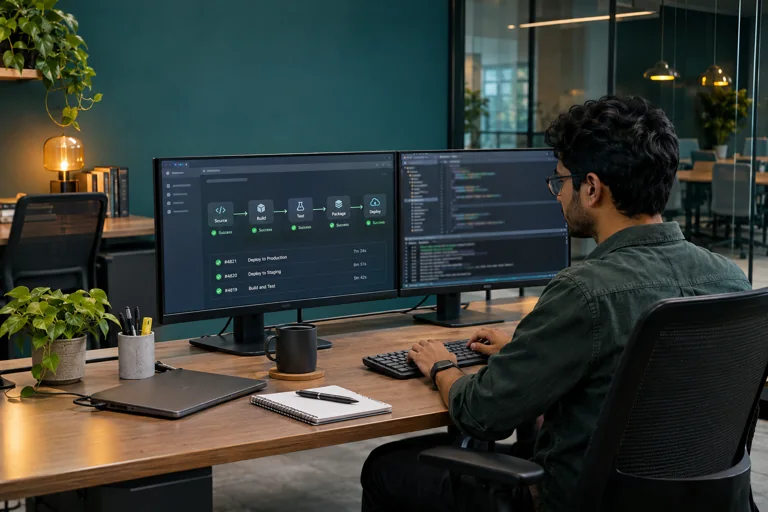
Source and scope are identifiable.
Check the real workflow and its exceptions.
Without approval, do not release.
Then verify production; follow the agreed recovery plan if checks fail.
A software rollback does not undo changed records or sent messages.
If a check fails, stop and follow the agreed recovery plan. Rolling back software does not automatically undo changed records or messages already sent.
Settings differ between environments, the required command is buried in a message thread, and a successful build is mistaken for a successful release. After a change it is difficult to know which version is running and which data has already been transformed.
We make steps explicit and repeatable. Automation helps execute an agreed process, but does not replace a risk decision or authorisation to change a working system.
We record the application, dependencies, configuration and data changes. Source code is kept separate from secrets and environment settings. The release has clear provenance so it can be verified and compared with the running version.
We select automated and manual checks for the actual risk. A test environment must not silently send real emails, change external systems or process real payments. Differences from production are documented rather than hidden.
We prepare the sequence, permissions and change window. We check dependencies and necessary backups. After launch we verify a selected user journey, such as creating an enquiry, opening material or passing an order.
We establish in advance when to stop a release, when an application rollback is possible and when data recovery is needed. A reversible version change and an irreversible data-structure change are not the same scenario.
Seeing a new page is not enough. We check content editing, saving, neighbouring pages, required locales and a selected contact path. The current version and theme's capabilities are considered separately.
We test a repeated event, delay and lost response. A retry must not create a second order or repeat an action already performed. An unknown result is first reconciled with the external system's state.
What changes, who authorises the transition and which data may be affected.
Versions, configuration, secrets and required dependencies are kept separate.
Run tests and a business scenario before cutover, then verify in the working environment.
What was released, which checks passed and what to do about remaining risk.
Limit: After launch we help maintain the process: update dependencies, refine checks and investigate failed releases. We do not build a complex delivery platform where a simple reliable process is sufficient.
A clear release scope, repeatable sequence and record of the result. The team can see which checks ran, who authorised the change and what recovery path is available. This reduces dependence on individual memory without removing human responsibility.
For a small project, a reproducible build and careful update of one application may be enough. For a container stack, pNet records the image, configuration, database migration, attachments and dependencies, separating preparation, testing and authorised release across environments. A Git commit, a new Docker version and a successful process start do not equal an accepted business change.
For example, a change to salon booking is tested against rescheduling and double bookings; a new academy registration method against allocation of places and access; a supplier catalogue against consistency of product, order and document. These examples determine release acceptance checks.
Restoring a previous image does not always undo changed data or messages already sent. Therefore, checks and recovery, data compatibility and a plan for partial outcomes are designed before launch. Kubernetes and automatic rollout remain options when a need is demonstrated, not mandatory complexity for every website.
Note: rolling back an application version does not undo sent emails, third-party payments or already changed data. These need separate rules.
Production changes, data migrations and external actions require explicit approval. Rollback feasibility and data compatibility are reviewed before release; automation does not remove these decisions.
Describe your systems, the problem and any known constraints. You do not need a complete technical specification. Please leave passwords, keys and customer data out of your message.
No. We start with the team's scale and risk. A versioned process, a few useful checks and explicit authorisation are often better than a complex system without an owner.
No. It confirms only its own stage. Deployment, application state and the working scenario are checked separately.
No. External actions and data changes may be irreversible. The return plan is defined before release and tested within the agreed scope.
Some actions can remain manual if they have a clear reason, instructions and confirmation. The goal is a controlled process, not automation for its own sake.
Tell us how changes are delivered today and where errors or dependence on one person arise. We will choose a first verifiable process.